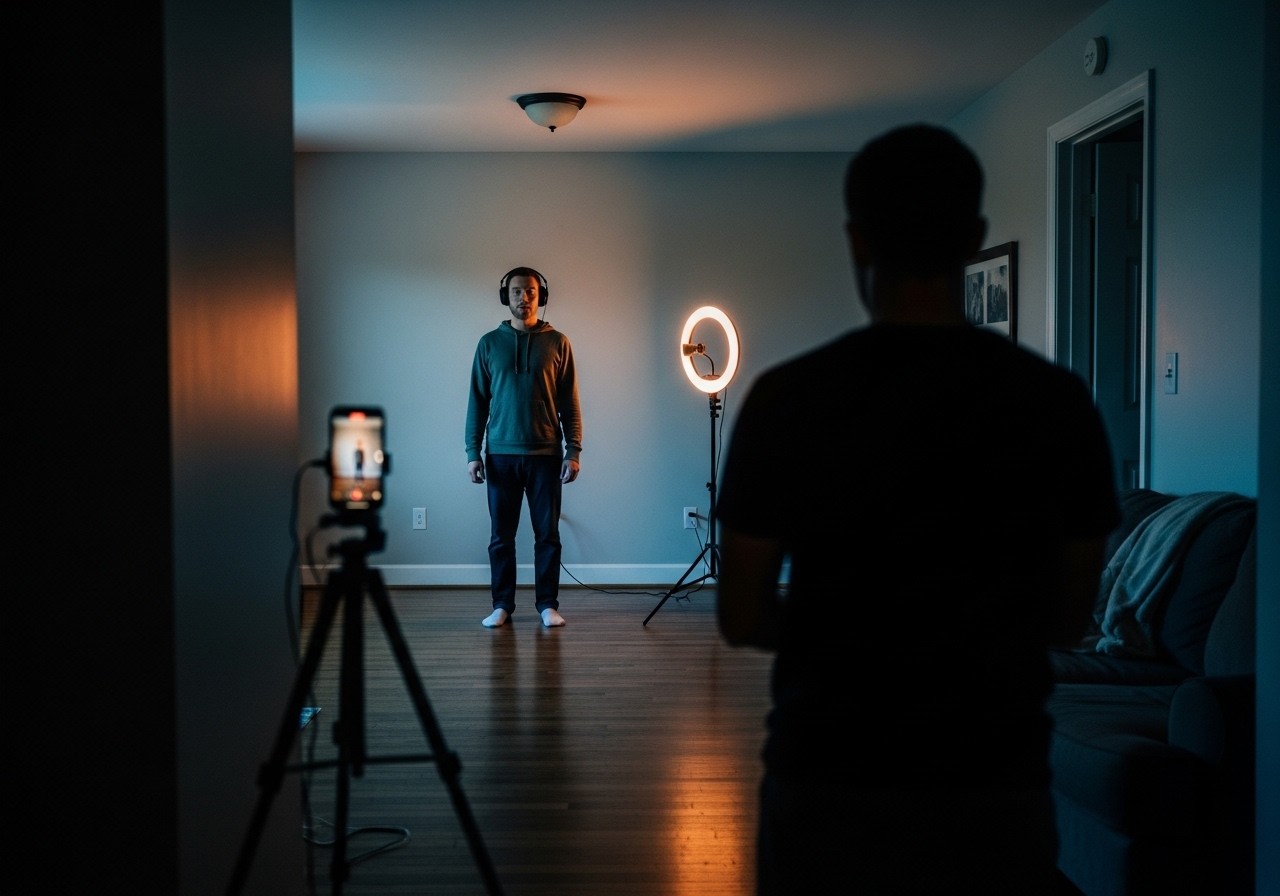
The self-tape was supposed to be a practical workaround. It turned out to be the most significant structural change to the acting profession in a generation. Here's what was gained, what was lost, and what it means for every working actor now.
It is easy to talk about the self-tape as a logistical development — a more efficient delivery mechanism for audition performances. That framing misses what actually happened.
The widespread adoption of self-tape auditions didn't just change the process of auditioning. It fundamentally altered the conditions of professional acting: the skills required to sustain a career, the economics of the audition market, the relationship between actors and casting, and the infrastructure an actor needs to operate professionally in the modern industry.
Some of what changed is unambiguously good. Some of it has created new pressures that the profession is still working out how to address. This article is an honest account of both.
What the Self-Tape Got Right
It democratised geographic access
Before the self-tape became standard, the professional audition market was heavily concentrated in two or three cities per territory: London, New York, Los Angeles, Sydney. Actors based outside those centres had structurally limited access to the highest-value casting opportunities, regardless of their talent. The commute to London for a first-round audition that might last four minutes was a genuine career obstacle for actors in Edinburgh, Cardiff, Belfast, or any regional city.
The self-tape removed that barrier. An actor in Manchester, Dublin, or Cape Town now has access to the same brief, the same deadline, and the same opportunity as an actor living two blocks from the casting office. This is a genuine democratisation of access, and its effects are still compounding across the industry.
It expanded the talent pool that casting can see
From the casting director's perspective, self-tapes made it economically viable to see a far larger pool of actors for any given role. An in-person first round at a major London casting office might accommodate forty or fifty actors in a full day. A self-tape brief for the same role can yield two hundred submissions, viewable asynchronously at a fraction of the time cost.
This has created genuine opportunities for actors who, in the in-person era, would simply never have been in the room. Actors without established relationships with certain casting directors. Actors from backgrounds underrepresented in the in-person audition pool. Actors whose type only makes sense once you see them perform — which a strong self-tape enables in a way that a headshot never could.
The self-tape made it possible for an actor in any city in the world to be seen for the same role at the same moment as an actor in Los Angeles. That is not a small thing. |
It put the actor in control of their own context
The in-person audition room was never neutral. Everything from the casting assistant's mood when you signed in, to the chair positioning, to whether the previous actor ran long and cut into your preparation time — all of it was outside your control and could affect your performance.
The self-tape gives you the room, the setup, the preparation time, and the number of takes. You decide when you're ready to record. You decide which take is your best work. The variables you control in a self-tape are meaningfully greater than those you controlled in the in-person audition room.
This is one of the underacknowledged advantages of the self-tape era: the actor who prepares well and knows how to create the conditions of their own best work now has a genuine edge over the actor who relies on the energy of the room to perform. Preparation quality has become more important, not less.
What the Self-Tape Took Away
The spontaneous connection
Something real was lost when the in-person first round became the exception. The casting director in the room — their genuine response, their ability to redirect, their visible engagement with your work — was a form of feedback that no self-tape submission can replicate. Actors who do their best work in genuine human exchange lost something in this transition.
More significantly, the in-person audition allowed casting to see the whole actor — how they entered the room, how they handled redirection, how they responded to the unexpected. These are things that matter enormously on set, and they are genuinely harder to evaluate from a self-tape.
The informal network building
In-person auditions were not just auditions. They were industry events — places where actors were seen by people whose memories and impressions compound over time. Being recalled to a casting office, or chatting to a director in a corridor, or being seen by a producer attending an in-person session: these informal encounters have generated careers in ways that are invisible in hindsight.
The self-tape, by definition, removes the actor from the physical space of the industry. Networking, visibility, and informal relationship-building now require deliberate effort in ways they didn't when the audition room provided natural opportunities for them.
The in-person audition room was never just an audition. It was also a place where industry relationships were built through physical presence. The self-tape era made that invisible work more deliberate — and for some actors, harder. |
The feedback loop
In an in-person audition, the reaction in the room is immediate feedback — however limited. A casting director's engagement, the energy shift when something lands, the quality of attention in a redirect: all of these gave actors some signal about whether their work was connecting.
The self-tape provides none of this. You submit into silence. The response rate for self-tapes — even for submissions that receive genuine consideration — is low. The structural absence of feedback makes it genuinely difficult for actors to know whether their work is landing or where their preparation needs to develop. This is one of the areas where coaching and structured self-assessment become more valuable, not less.
The New Competencies: What the Self-Tape Era Actually Demands
The actor who thrives in the self-tape era is not simply the best performer. They are the best performer who also has the following:
Technical production literacy
Framing, lighting, audio, editing, file format, delivery platform — these are now professional skills, not optional extras. The actor who cannot consistently produce technically professional submissions is at a structural disadvantage, regardless of their performance quality. Drama school curricula are catching up to this reality, but many are still behind.
→ RADA (rada.ac.uk) — Royal Academy of Dramatic Art, London
→ LAMDA (lamda.ac.uk) — London Academy of Music and Dramatic Art
→ Juilliard School (juilliard.edu) — New York
Brief compliance discipline
Casting directors consistently report that a significant proportion of self-tape submissions fail on technical compliance — wrong framing, missing slate, incorrect number of takes, ignored file naming conventions. These are avoidable losses. The actor who reads the brief completely, extracts every requirement, and confirms compliance before recording has eliminated a category of failure entirely.
Repeatable preparation systems
The volume of self-tape requests now arriving at professional actors has made ad hoc preparation economically unsustainable. An actor receiving three briefs in a week, each with a 48-hour turnaround, needs a system — not a hope that the right mood will arrive.
This is precisely why The Actors Copilot exists. The Brief Breakdown and Character Sides Breakdown are not conveniences. They are the structural response to a real problem created by the self-tape era: how do you maintain preparation quality at volume, under deadline pressure, without the external support structures of an in-person industry?
Digital presence
In the in-person era, the headshot and CV were the only materials that preceded an actor into the casting room. In the self-tape era, casting can look you up before they've decided whether to open your submission. Your digital footprint — what exists, what it says, how consistent it is — is now part of your professional presence in a way it simply wasn't a decade ago.
What Comes Next
The technology layer being built around auditions is not finished. AI-assisted casting discovery, digital profile searchability, and performance analysis tools are all in active development across the major casting platforms. The actors best positioned for the next five years are the ones who understand this trajectory now — not the ones who wait for the industry to demand adaptation before they respond.
The consistent truth, across every technological shift in the audition process, is that the actors who engage earliest with new tools and use them to improve the quality of their craft — rather than viewing them with suspicion — are the ones who move forward while others wait.
The self-tape was a revolution. What's coming next is an evolution. The actors who thrive in both are the ones who never stopped investing in the thing that no technology can replace: specific, truthful, personal performance. The tools change. The craft doesn't.
Build the system that supports your craft — every audition, every time — theactorscopilot.com
Sachez ce dont votre personnage a besoin, verrouillez rapidement vos choix et récupérez du temps pour ce qui compte—votre performance.
FAQ
Est-ce que cela remplace les acteurs ou la créativité?
Non. Cela soutient votre processus. Les choix vous appartiennent toujours.