Casting sees your setup before they hear a word you say. Here's how to build a home self-tape environment that works for you — not against you.
There's a version of the self-tape world that doesn't get talked about enough: the part where you're not just the actor, but also the director of photography, the sound recordist, the lighting operator, and the editor. Before a single word of your performance reaches a casting director, every technical decision you've made is already being registered.
The good news is you don't need a professional studio. You need a consistent, well-considered setup that you control. One that removes the technical variables so that what casting is evaluating is your performance — not your lighting rig.
Why Your Setup Is Part of Your Performance
Think about what happens in the first three seconds of any self-tape. Before the first line, a casting director has already clocked the image quality, the audio tone, the framing, and the background. They have formed an unconscious impression.
If any of those variables are off — muddy sound, unflattering backlight, a cluttered shelf visible over your shoulder — that impression is already a slight negative that your performance has to overcome. A clean, professional setup removes that obstacle entirely. It puts the casting director in the right state to receive your work.
The Four Variables You Actually Control
Light
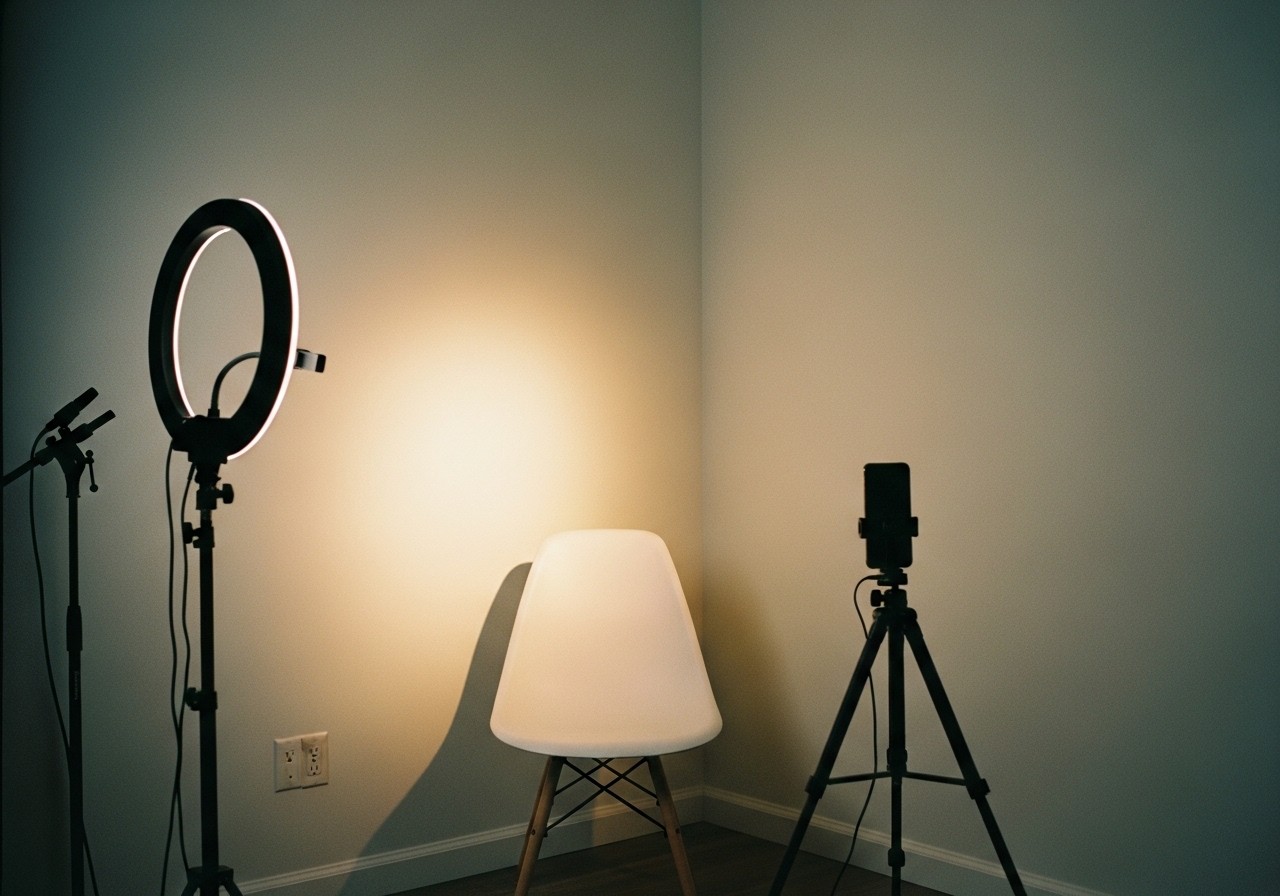
This is the highest-leverage variable. Bad lighting is the single most common reason a technically clean performance fails to land on screen. You want one primary source of clean, even light on your face — something that illuminates without casting harsh shadows under your eyes or chin.
A simple LED ring light or a softbox positioned at face height, slightly in front of you, will serve most actors well. The goal is diffused, directional light. Natural window light works if the window is in front of you — never behind you. If the window is behind you, you are a silhouette, and that is a submission that won't get watched.
Background
Plain and controlled. A flat wall — white, grey, or a warm neutral — gives casting nothing to look at except you. This is the point. Any texture, colour or object in the background that draws the eye is competition you don't need.
You don't need a backdrop stand. A clear wall in your home, properly lit, is entirely sufficient. If colour is present in the brief — a production with a specific visual world — a very subtle background choice can be intentional. But the default is: clean, neutral, yours.
Audio
Poor audio is the fastest way to get a tape closed. If casting has to strain to hear you, they won't. The human voice communicates performance through texture, breath, rhythm, and tone — all of which audio compression and room echo destroy.
A USB condenser microphone or a decent lapel mic will transform your audio quality for under £50. A room with soft furnishings — books, fabric, a sofa — naturally reduces echo. Avoid hard-floored, bare-walled rooms. Record a thirty-second test and listen back on headphones before you begin.
Framing
Mid-shot — roughly from the chest up — is the industry standard unless the brief specifies otherwise. Your eyes should sit in the upper third of the frame. The camera should be at eye level. If you're shooting on a phone, use a tripod or stack it at the right height. Never shoot from below. It is not a flattering angle and it signals an improvised setup.
Check your eyeline. If the brief specifies 'slightly off-camera', mark a point just beside the lens and hold it there consistently. Eyeline inconsistency in a multi-take tape reads as lack of preparation.
What You Don't Need
You do not need a professional camera. Modern smartphones shoot in a quality that is entirely sufficient for self-tape submissions. You do not need a green screen. You do not need complex lighting rigs. You do not need a separate editing suite.
What you need is consistency. The same setup, the same quality, every tape. Casting directors who receive multiple tapes from the same actor notice when the setup changes — and variable quality creates a variable impression.
Building the Habit
Treat your setup like your rehearsal space. Once it's dialled in, it should take you five minutes to be ready to record — not forty-five. The technical side of self-taping should become invisible so that you arrive in front of the camera already thinking about the scene, not about whether your light is positioned correctly.
The Actors Copilot's Casting Director's Brief Breakdown includes a technical checklist that confirms every setup requirement from the brief before you roll on a single take — so you're never mid-shoot when you realise you've missed an eyeline note.
Build a system that makes every tape count — theactorscopilot.com
Know what your character needs, lock your choices fast, and buy back time for what matters — your performance.
FAQs
Is this replacing actors or creativity??
No. It supports your process. The choices are always yours.