How a practical workaround for remote actors became the industry standard — and what that shift has meant for every working actor on earth.
The self-tape is now the default first round of almost every professional audition. It is so embedded in how the industry operates that actors who entered the profession in the last decade could be forgiven for thinking it was always this way.
It wasn't. The self-tape has a specific history — one that tracks technological change, industry economics, and the evolving relationship between actors and the casting process. Understanding that history isn't merely interesting. It changes how you see your position in the current landscape, and what skills actually matter now.
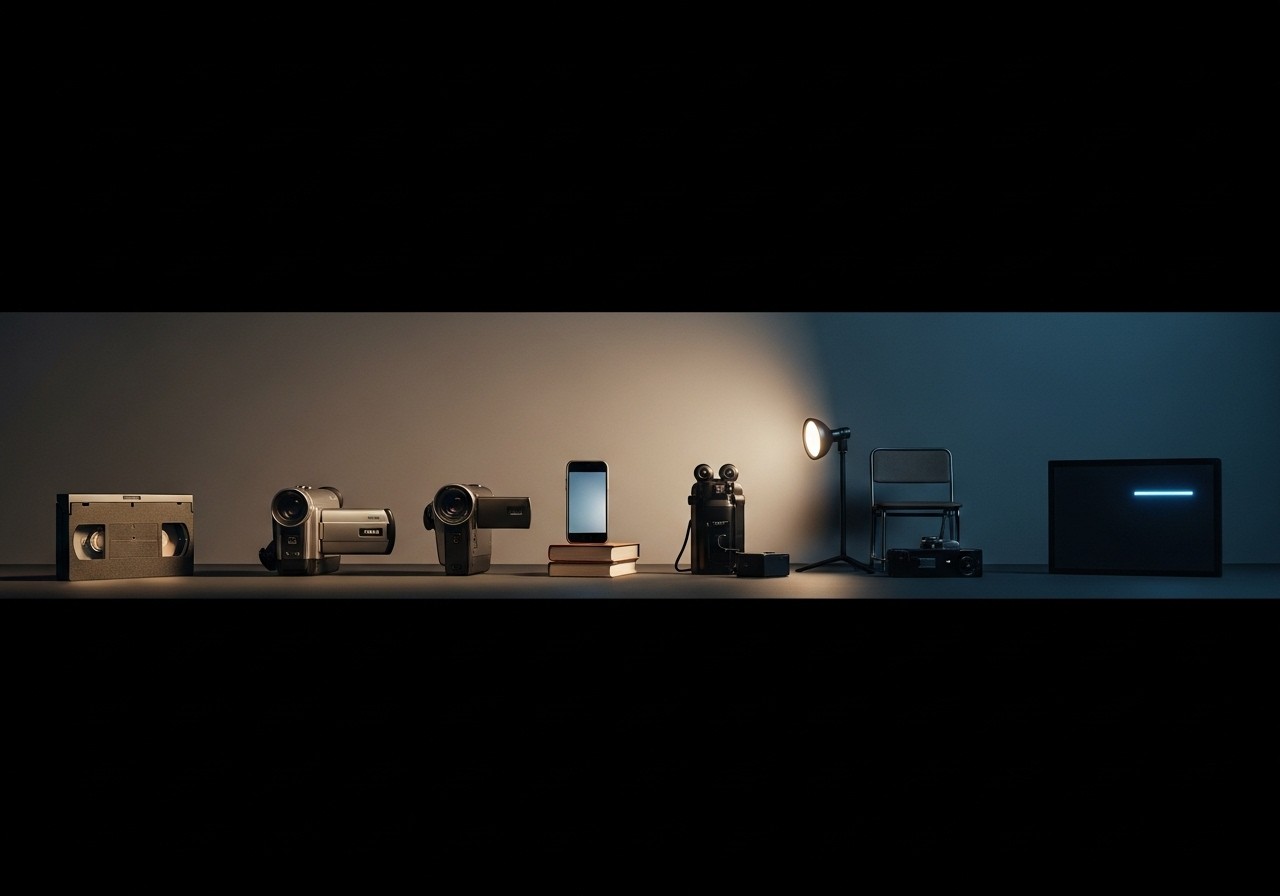
The VHS Era: The First Remote Auditions (1980s–1990s)
The origins of the remote audition predate digital technology by decades. By the mid-1980s, casting directors in major markets — primarily Los Angeles and New York — were beginning to request video submissions from actors based in regional markets or overseas territories who could not reasonably travel for a first-round audition.
The format was VHS. Actors would film themselves on consumer camcorders — often with the help of a friend or drama school colleague — and mail a physical cassette to the casting office. The process was cumbersome, expensive by the standards of the time, and technically inconsistent. Quality varied enormously depending on the equipment available to the actor and the space they had access to.
What the VHS era established, however, was the foundational principle that would shape everything that followed: the performance could be evaluated separately from the actor's physical presence in the room. Casting need not be geographically constrained. This was a structural shift, even if the infrastructure to support it widely didn't yet exist.
The VHS audition tape established the principle that would reshape the entire industry: geography need not determine who gets seen. |
DVD and the Early Digital Transition (Late 1990s–Mid 2000s)
The transition from VHS to DVD in the late 1990s brought incremental improvements to the remote audition process. Physical media remained the primary delivery mechanism, but DVD offered better image quality, chapter navigation, and durability. More significantly, the emergence of consumer digital cameras — replacing analogue camcorders — began to stabilise the quality of submissions.
This period also saw the first casting platforms beginning to build digital databases of actor materials. Spotlight, which had been operating as a printed directory since 1927, launched its online platform in 1998, beginning the transition of actor profiles from physical catalogues to searchable digital databases. In the United States, Actors Access — a product of Breakdown Services, founded by Gary Marsh in 1971 — was evolving toward digital submission infrastructure.
→ Spotlight (spotlight.com) — the UK's primary casting platform, operating since 1927
→ Breakdown Services / Actors Access (actorsaccess.com) — founded 1971, the US submission standard
The period was characterised by transition rather than transformation. The industry was moving toward digital infrastructure, but the physical audition room remained the primary venue for serious casting decisions. Remote submissions were still the exception rather than the rule.
Broadband Internet and the Email Revolution (Mid 2000s–2012)
The widespread availability of broadband internet in the mid-2000s changed the economics of remote audition in ways that the industry hadn't fully anticipated. For the first time, it became genuinely practical to deliver video footage digitally — first as email attachments, then through early file-sharing services and upload platforms. The physical cassette began its decline.
YouTube, launched in 2005, and Vimeo, launched the same year, gave actors a way to host video content online and share links rather than physical media. While neither platform was designed for professional audition use, both were rapidly adopted by actors and later, selectively, by casting professionals. The link-sharing model — which remains standard practice today — was established in this period.
Smartphone video quality improved dramatically from 2007 onward, following the introduction of the iPhone and the subsequent rapid iteration of mobile camera technology. By 2010, a mid-range smartphone could produce video footage of sufficient quality for a casting submission. The barrier of specialist equipment — which had shaped the remote audition since the VHS era — was effectively removed.
The smartphone removed the equipment barrier that had defined remote auditions since the 1980s. What had been a specialist technical process became something any actor could do from their living room. |
The Self-Tape Becomes Standard (2012–2019)
The shift from 'remote auditions are sometimes requested' to 'self-tapes are expected for most first rounds' happened gradually between approximately 2012 and 2019. Several converging factors drove it.
Casting director workloads increased substantially as the volume of content being produced — driven first by the expansion of cable television and then by the explosive growth of streaming platforms — grew faster than casting infrastructure. By 2016, Netflix alone had committed to producing over 600 hours of original content annually. Amazon, Hulu, Apple, and the established broadcast networks were all scaling simultaneously. The demand for actors was growing faster than the capacity of traditional audition rooms to process them.
Self-tapes offered casting a more efficient first filter. Rather than scheduling and hosting hundreds of in-person first-round auditions for significant roles, casting could issue a self-tape brief and review submissions asynchronously, at scale. The actors who could produce professional-quality self-tapes — consistently, on deadline, with strong choices — began to move through the process faster than those who couldn't.
The shift also changed something about the actor's relationship to preparation. In the in-person audition, the casting director and the room provided external structure. In the self-tape, the actor was responsible for creating the conditions of their own best work. Setup, framing, sound, eyeline, slate, number of takes — all of it was now the actor's domain.
→ Screen International (screendaily.com) — primary trade publication for the international film industry
→ Deadline Hollywood (deadline.com) — streaming content volume data and industry reporting
The Pandemic and the Point of No Return (2020–2021)
The COVID-19 pandemic did not create the self-tape era. It accelerated a transition that was already well underway and made it permanent in a way that even industry sceptics could not reverse.
From March 2020, with physical production suspended globally and casting offices closed, the self-tape became the only available mechanism for audition. Casting directors, directors, and producers who had previously resisted remote submissions out of preference for in-room dynamics had no alternative. The infrastructure, the workflows, and the professional acceptance of self-tapes were all forced to mature simultaneously.
What emerged from the pandemic period was a recalibrated industry norm: even as in-person productions resumed, the self-tape was retained for first rounds and callbacks in the majority of productions. The cost and time savings — for both casting offices and production companies — were too significant to abandon. The in-person audition room survived, but it became the later-stage exception rather than the standard entry point.
The pandemic didn't create the self-tape era. It made it permanent. By 2021, the in-person first-round audition had become the exception in almost every professional market worldwide. |
AI Enters the Audition Workflow (2022–Present)
The integration of artificial intelligence into the audition and casting workflow is the most recent and still-developing chapter in this history. It is happening across several distinct areas simultaneously.
AI-assisted casting discovery
Platforms including Spotlight, Mandy, and their US equivalents have begun incorporating AI-driven search and filtering tools that allow casting to query actor databases by combinations of criteria that would previously have required manual trawling. Physical type, accent range, credit history, and in some implementations, reel content analysis — all are being deployed at scale.
Tape review assistance
Some casting offices are piloting AI tools that handle the first technical pass of self-tape submissions — flagging framing errors, audio issues, missing slates, and brief non-compliance before a human reviewer sees the tape. This does not replace the casting director's creative evaluation. It filters the pool before that evaluation begins.
Actor-first AI: performance preparation
The third category — and the one most directly relevant to working actors — is AI built to serve the actor's preparation process rather than the casting office's workflow. This is the space The Actors Copilot occupies: AI that translates casting briefs and sides into structured, playable character breakdowns grounded in the actor's own Personal DNA, so the choices that reach the camera are specific, truthful, and consistently produced regardless of deadline pressure.
This distinction matters. AI that replaces the actor's work and AI that supports the actor's work are not the same category, and conflating them produces the kind of anxiety that serves no one. The history of self-tapes is partly a history of actors adapting to new tools and using them to do better work. The current AI moment is the next chapter of that same story.
→ Spotlight (spotlight.com) — AI-assisted casting tools and profile search
→ Mandy.com — global casting and crew platform
→ Backstage (backstage.com) — the US resource for actors on auditions, casting, and industry news
What the History Tells Us
The arc from VHS to AI contains a consistent through-line: every major technological shift in the audition process has expanded the pool of actors who can be seen by casting, while simultaneously raising the baseline standard for what 'professional' looks like.
VHS made regional and international actors accessible to major-market casting. Digital technology removed the equipment barrier. Broadband removed the geography barrier. Streaming demand expanded the number of roles available. AI is now beginning to shift how those roles are discovered and how preparation quality is measured.
At every stage, the actors who adapted earliest — not the ones who resisted — were the ones best positioned for what came next. The self-tape isn't going away. Neither is the AI layer being built around it. The question, as it has always been, is whether you're building the skills and systems to use these tools in service of your craft — or waiting to see what the industry demands before you respond.
Start preparing like a professional — every audition, every time — theactorscopilot.com
Know what your character needs, lock your choices fast, and buy back time for what matters — your performance.
FAQs
Is this replacing actors or creativity??
No. It supports your process. The choices are always yours.